Why Latin America
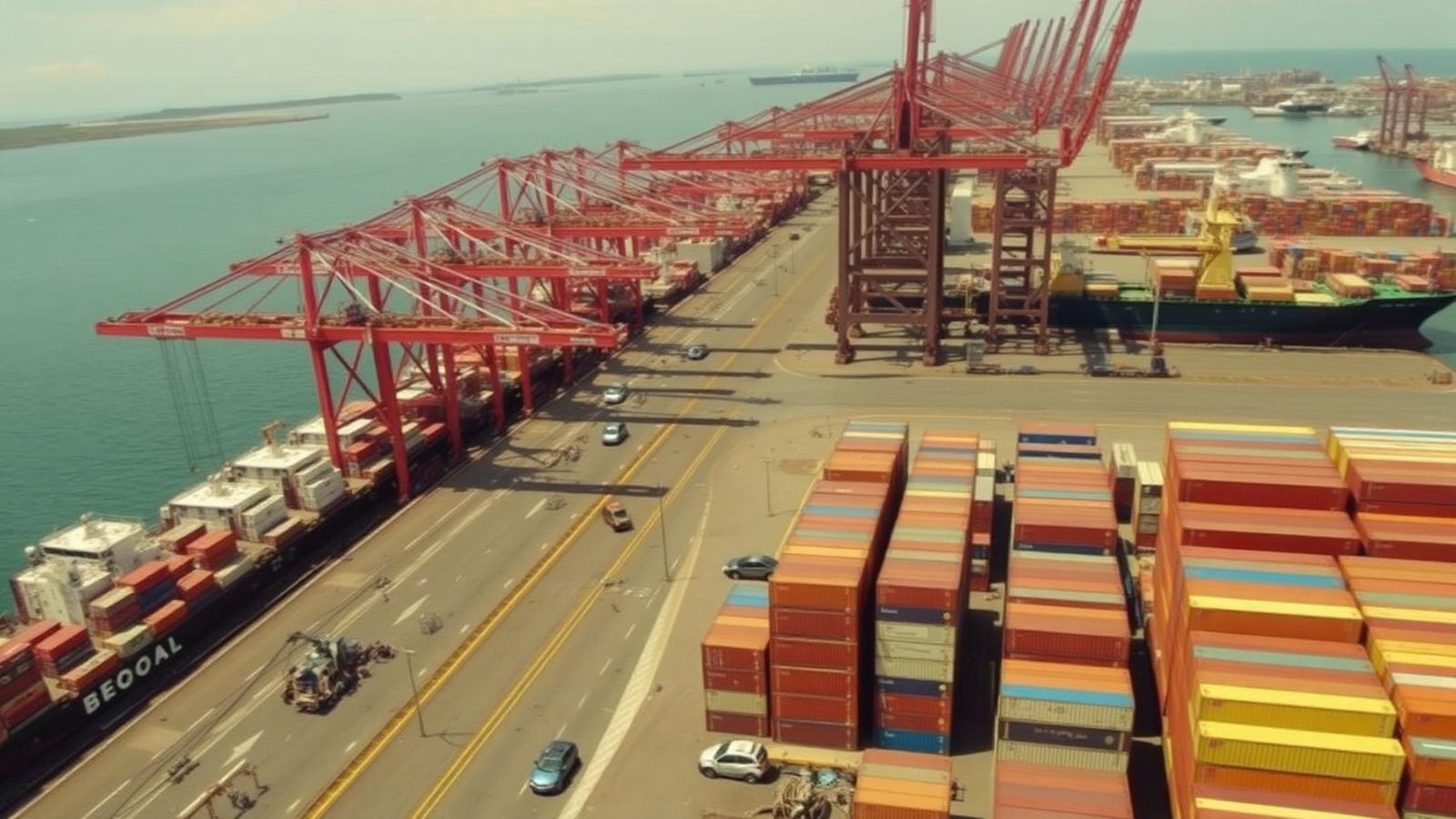
Demand for assurance is growing while supply stays small and fragmented. The region supplies global markets with minerals, food, energy and manufactured goods. Every one of those flows requires independent verification.
Why assurance demand keeps growing
- 01
Export-oriented economies
Latin America supplies roughly 16% of global food and agricultural exports. Mining, agriculture, protein, energy and manufactured exports all carry testing, inspection and certification requirements set by destination markets.
- 02
Infrastructure and energy investment
Energy investment in the region runs near USD 160 billion a year, with clean-energy spending around USD 70 billion. Renewables already supply over 60% of the region's power. Every plant, pipeline, grid and renewable project requires commissioning, materials testing and inspection.
- 03
Nearshoring
New industrial capacity is relocating closer to North American demand, bringing compliance, calibration and quality assurance requirements with it.
- 04
Tightening standards
Food safety, environmental and product standards continue to converge upward with those of major import markets. Rules such as the EU's CBAM and food-safety modernization are tightening access to export markets.
- 05
Supply-chain scrutiny
Buyers increasingly require traceability and third-party verification deep into their supplier base.
Why provision remains fragmented
Most providers are founder-owned and single-country
More than 10,000 independent labs and inspection firms operate in the region. Almost all of them serve one country only, so a client with sites in three countries needs three different suppliers.
Growth capital is scarce outside the largest operators
Owners fund new equipment and new accreditations out of cash flow. That limits how fast they can add tests, open branches or take on larger contracts.
Accreditation scope is often narrower than client demand
A lab may hold accreditation for part of what a client needs and subcontract the rest. Work then leaves the region or goes to a competitor.
Commercial functions are typically informal or founder-dependent
Sales, pricing and key client relationships usually sit with the owner. There is rarely a sales team, a CRM or a formal pricing structure behind them.
Succession planning is frequently unresolved
Many founders are approaching retirement with no internal buyer and no obvious external one. The business is valuable, but there is no clear way to transfer it.
Digital reporting and client portals are underdeveloped
Results are often delivered by email or PDF. Clients increasingly expect live dashboards, data feeds and audit trails they can query themselves.
Fewer than 30% of providers are fully digital
The remaining majority still run on paper, spreadsheets or partial systems, which caps turnaround times and makes multi-site reporting slow.
Cross-border client coverage is rare below the multinationals
Regional and global clients want one contract, one standard and one report across markets. Below the multinationals, almost nobody in Latin America can offer that today.
Where Latin America is globally significant
We prioritise sectors where the region matters to the world and where certification is a condition of market access.
Mining and minerals
LATAM accounts for roughly 41% of global copper, 32% of lithium and 51% of silver. Chile alone accounts for about 28% of global copper supply and 53% of Latin American mining investment.
Food and agriculture
Brazil exports over USD 160 billion of agriculture, Chile more than USD 24 billion of food, and Peru around USD 12 billion as the world's leading blueberry exporter. The dedicated LATAM food-testing market is forecast to roughly double from about USD 1.7 billion in 2025 to USD 3.1 billion by 2033.
Energy and infrastructure
Chile passed 40% solar and wind in 2024. Brazil's recent transmission auctions committed close to USD 4 billion to build some 7,300 kilometres of new lines. The regional project pipeline approaches USD 138 billion.
Pharma and medical devices
Latin American pharmaceuticals are projected to grow from about USD 98 billion in 2025 to roughly USD 173 billion by 2034. Nearshoring of medical-device manufacturing is expanding: Costa Rica alone exported around USD 7.6 billion of medical instruments in 2024.
Figures are estimated and drawn from publicly available sources.
Risks we take seriously
Latin America carries real risks. We name them plainly and manage each one with a specific, structural answer rather than optimism.
Currency volatility
Local currencies can move sharply against the US dollar. Our answer: revenue and costs are matched in the same currency wherever possible, contracts are repriced on defined cycles, and cash is diversified across several countries so no single devaluation drives group results.
Political and regulatory change
Governments and rules change. Our answer: no country holds a dominant share of group revenue, and testing, inspection and certification demand is driven by destination-market rules (EU, US, Asia) rather than local politics, so mandates survive changes of government.
Accreditation and technical standards
Each country runs its own accreditation bodies and audit cycles. Our answer: accreditation is treated as a core asset with dedicated quality leadership, scheduled audit calendars, and shared method libraries so scopes are maintained and extended rather than lost.
Technical talent
Qualified inspectors, analysts and metrologists are scarce and mobile. Our answer: local management keeps genuine authority, career paths and training are funded across the network, and technicians can be shared between companies to smooth demand peaks.
Integration risk
Consolidation fails when it strips out what made a business good. Our answer: brands, client relationships and technical teams stay in place; we standardise only finance, quality systems, safety and reporting.
Capital discipline
Leverage magnifies every other risk on this list. Our answer: conservative capital structures, cash-generative businesses, and growth funded to a pace the network can absorb operationally.
Risk management is an operating discipline here, not a disclosure paragraph. It is reviewed at network level every quarter.